
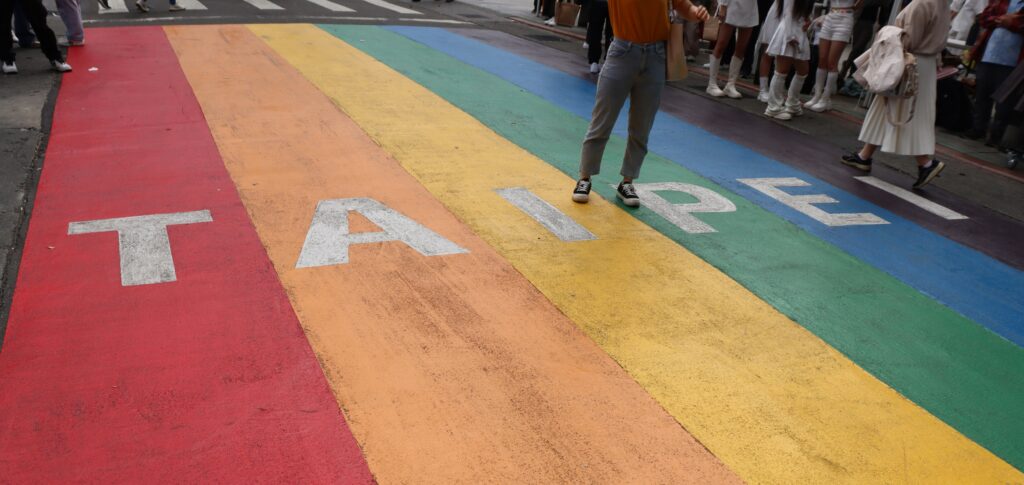
Taipei Pride Defies Local Crackdown with Historic 170,000-Strong March
A recent police raid transformed Taiwan’s 2026 Pride Parade as more than 170,000 marchers flooded the streets for the 24th annual Taiwan LGBT+ Pride parade, turning East Asia’s largest celebration of inclusivity into a massive demonstration of solidarity.
Marching under the official slogan “Our Voices, Our Journey,” participants donned elaborate costumes, waved rainbow flags, and filled the city with music and dance. However, this year’s festive atmosphere carried an undercurrent of fierce political defiance following a controversial police incident just weeks prior.
The Lead-Up: Pride Tinged with Anger
The celebration followed intense public scrutiny and anger directed at local law enforcement. Earlier in October, Taipei police conducted a heavy-handed raid on Commander D, a popular gay bar in the city’s Ximen neighborhood. Officers detained 51 patrons and arrested the owner over alleged violations of public decency and nudity laws.
Rights groups and critics slammed the operation as an abuse of authority, citing invasive personal searches and humiliating treatment by police. In response to the backlash, organizers with the Taiwan Rainbow Civil Action Association revised the event’s sub-themes to directly address state overreach. Organizers noted that the raid “reawakened the historical trauma of sexually and gender-diverse communities long subjected to oppression by state authorities”.

Though Taipei Mayor Chiang Wan-an issued public apologies and disciplined six officers, he faced a barrage of boos and angry jeers when he appeared at the rally on Saturday. Concurrently, prominent democratic leaders sought to reassure the community; Vice President Hsiao Bi-khim led the Democratic Progressive Party (DPP) delegation, and President Lai Ching-te explicitly declared on social media that “this respect must also be reflected in every exercise of public authority”.
Why Taiwan Pride Matters
As the marquee event in East Asia, Taiwan Pride serves multiple critical dimensions:
- A Regional Beacon of Hope: Having legalized same-sex marriage in 2019, Taiwan stands as a pioneering bastion of LGBTQ+ human rights in Asia. The parade draws thousands of international attendees from neighboring countries where legal protections do not exist.
- Resistance to Anti-DEI Backlash: Organizers emphasized that this year’s mobilization was vital for combating political polarization and global pushback against diversity, equity, and inclusion initiatives.
- Highlighting Domestic Gaps: Despite high levels of legal equality—including expanded cross-national marriage and adoption rights—marchers emphasized that social acceptance remains a hurdle. Many youth still face family rejection or institutional biases, which underscores the parade’s persistent necessity.
The parade wound seamlessly through the northern and southern corridors of downtown Taipei, beginning and ending at the City Hall Plaza. Despite scattered clouds and brief afternoon showers, the sheer turnout proved that the community’s voice remains as resilient as ever.
But Taiwan Pride’s monumental footprint extends beyond a single afternoon. To understand the full scope of East Asia’s most progressive LGBTQ+ movement, the legal milestones, key geographic pathways, and earlier demonstrations provide vital context.
Taiwan has consistently served as a regional trailblazer, evolving from a grassroots movement in the late 20th century into a constitutional vanguard of human rights. The first government-sponsored Taiwan Pride march took place in Taipei with a modest crowd of roughly 800 participants in 2003.
In 2017, Taiwan’s Constitutional Court delivered a landmark ruling declaring the Civil Code’s restriction of marriage to heterosexual couples unconstitutional, giving the legislature a two-year deadline to enact parity. Two years later, Taiwan officially legalized same-sex marriage through the Act for Implementation of J.Y. Interpretation No. 748, becoming the first place in Asia to do so.
In May 2023, the Legislative Yuan passed sweeping amendments granting same-sex couples full joint adoption rights for children to whom they have no biological relation. Then, from 2024 through this year, legal expansions have granted recognition to multinational marriages, including cross-strait Chinese nationals married abroad, further solidifying the island’s inclusive standing alongside regional peers like Nepal (2023) and Thailand (2025).
All that progress came out in full force. Starting at Taipei City Hall Plaza (Citizen Square), the crowd of 150,000 marchers divided into two distinct, color-coded loops that navigated the Xinyi and Da’an districts before converging back at the central stage. The North Route flowed from City Hall Plaza onto Ren’ai Road, cutting upward through Dunhua South Road and onto the bustling commercial strip of Zhongxiao East Road before circling back via Yixian Road.
The South Route traveled down Ren’ai Road toward Guangfu South Road, looping through Xinyi Road and Dunhua South Road before returning to City Hall Plaza. Along both routes, regular traffic merged seamlessly with massive sound trucks and thousands of domestic and corporate contingents.
Support for Trans March, Too
Before the main event on Saturday, an estimated 3,800 people took to the streets on Friday night, October 30, 2026, for the 8th Taiwan Trans March. Organized by the Taiwan Tongzhi (LGBTQ+) Hotline Association, the demonstration marched under the banner “Crossing Boundaries, Standing Together”. Gathering at 228 Peace Memorial Park, marchers walked west through Taipei’s historic Ximending shopping district—the epicenter of the city’s queer culture.
While celebrating solidarity, organizers utilized the Trans March to highlight critical, ongoing domestic barriers. Spokespeople emphasized that despite marriage equality, transgender individuals face severe online polarization, strict bureaucratic and medical prerequisites to alter legal gender markers, and systemic discrimination within corporate healthcare and educational settings.