
Could Virginia Finally Be for (Same-Sex) Lovers?
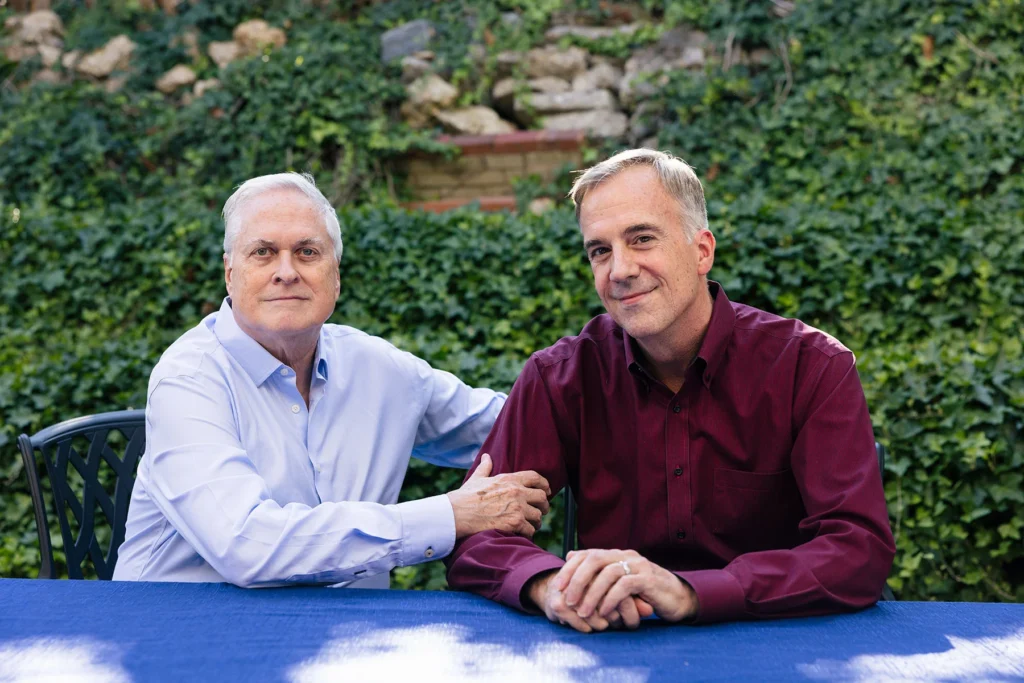
Bob and Bob have been married for 12 years. They’re ready for their state constitution to change. Virginia’s ban on same-sex marriage hasn’t been enforceable since 2014, but it’s still on the books — at least until November.
This story was originally reported by Brooke Migdon and Mel Leonor Barclay of The 19th. Meet Brooke and Mel and read more of their reporting on gender, politics and policy.
Even before gay marriage was legal in Virginia, Bob Connelly referred to Bob Witeck as his husband.
The couple met in 1994, after Connelly interviewed Witeck’s business partner for an episode of “Gay Spectrum,” a public-access cable television program in Fairfax County. Witeck tuned in when the episode aired and was immediately charmed by Connelly. He called his colleague and asked: “How do I meet him?”

That opportunity came about a month later, when Witeck and Connelly both attended a Human Rights Campaign fundraiser in Washington, D.C. “I saw Bob, and I went up to him, and in about 30 seconds I introduced myself and asked him out,” Witeck said. Eight months later, they were living together in Arlington.
At the time, same-sex marriage had been illegal in Virginia for close to two decades. The state legislature would add new restrictions in 1997, and nine years after that, voters would approve a constitutional amendment defining legal marriage as “solely between one man and one woman.”
Witeck and Connelly knew other gay couples who referred to one another as “partner.” “But to me, ‘husband’ was the proper way to speak of us,” Connelly said.
After two decades, they were finally able to make that title official. The couple legally married in 2014, on the 20th anniversary of the day that they met, after a federal judge struck down Virginia’s constitutional ban on same-sex marriage. “Our courts have never long tolerated the perpetuation of laws rooted in unlawful prejudice,” U.S. District Judge Arenda L. Wright Allen wrote in the decision, handed down on Valentine’s Day.
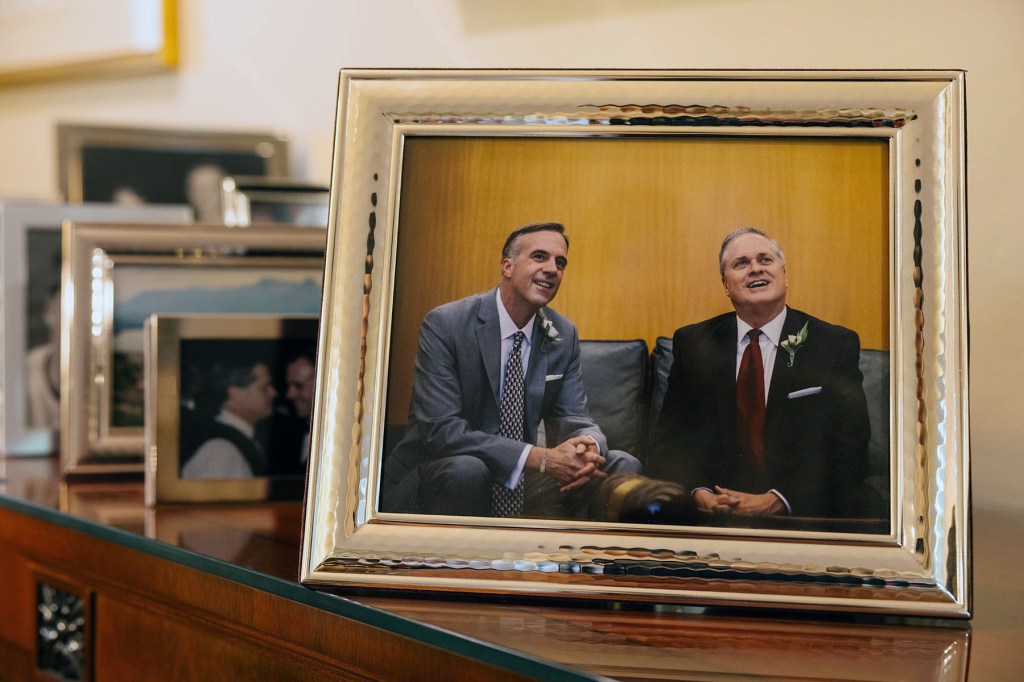
“It never occurred to us to pine for it until it became a reality,” Witeck said of his and Connelly’s freedom to marry. They tied the knot in a small ceremony officiated by a friend, alongside Connelly’s sister and her wife, who married several weeks earlier, also on the 20th anniversary of their first meeting.
Less than a year later, the Supreme Court issued its landmark ruling in Obergefell v. Hodges, which established a federal right to marry for same-sex couples in the United States.
Virginia’s constitutional amendment banning same-sex marriage has not been enforceable since 2014 — but it has remained on the books since it was adopted in 2006. Marriage equality advocates, including Witeck and Connelly, hope that will change come November, when voters will decide whether to strike it from the state’s constitution.
‘It took 20 years’
On Virginia’s ballot this year is a proposed amendment that would repeal the state’s constitutional ban on same-sex marriage and create an affirmative right to marriage between two consenting adults regardless of their sex, gender or race. It earned its spot after several failed attempts, and after Virginians elected Democratic majorities to the legislature last fall.
In Virginia, proposed amendments to the constitution must be approved by the state House and Senate twice before they can go before voters. Just eight Republicans in the 140-seat legislature voted in support of the amendment when it came up for final passage in January.
Former state Del. Mark Sickles — now Virginia’s finance secretary — is a Democrat and one of the original patrons of the proposal. He came out publicly in a 2014 Washington Post op-ed, after the court ruling that nullified Virginia’s constitutional ban on same-sex marriage caused some Republican lawmakers to publicly condemn the “LGBT lifestyle” and repeat harmful stereotypes about gay people.
“Hearing such caustic remarks yet again on the House floor, coupled with the overturning of our same-sex marriage ban, has motivated me to state publicly here what many close friends and family have known for decades: I am a proud, gay man,” Sickles wrote, becoming the second out gay member of the Virginia legislature.
Roughly a decade earlier, he had watched as his colleagues, including some Democrats, lobbied for the passage of what would ultimately become Virginia’s constitutional ban on gay marriage.
“I was depressed,” Sickles said of election night in 2006, when 57 percent of Virginians voted in favor of the ban. “I didn’t know how long it would take to get us to the point where it could be stripped from the constitution. It took 20 years to the day.”
Sickles said he doesn’t view the proposed amendment as symbolic, given recent decisions by the Supreme Court’s conservative supermajority and surveys that show support for marriage equality has fallen among Republicans.
The high court declined to take up a case challenging its same-sex marriage ruling last year, though two of the court’s leading conservatives — Justices Samuel Alito and Clarence Thomas — have previously criticized the decision as detrimental to religious freedom. In 2022, after the Supreme Court issued its landmark decision in Dobbs v. Jackson Women’s Health Organization, which overturned the federal right to abortion, Thomas wrote in a concurring opinion that the court “should reconsider” some of its other rulings, including Obergefell.
Overall, support for marriage equality in the United States remains high, with 65 percent of Americans registering support in a June Gallup poll. It’s an encouraging statistic to people like Sickles, who expects the outcome of Virginia’s November election to look markedly different from that of 20 years ago. “I’ll probably be at some party somewhere, raising a glass,” he said.
Other Virginia marriage equality advocates say they’re similarly optimistic about the proposal’s chances of passing.
“Folks are excited to not only vote for it, but to do what they can to help get out the vote,” said Narissa Rahaman, executive director of Equality Virginia and campaign manager for Virginians for Marriage Equality, the two primary organizations backing the proposal.
“Democrats and Republicans in Virginia support this amendment, from the folks we’ve been speaking to,” Rahaman said. “This is an amendment that impacts people on a very basic level.”
Rahaman and her wife, Breanna, who celebrated their third wedding anniversary in August, grew up in Florida and Texas, where voters approved similar amendments barring same-sex marriages around the same time as in Virginia, the couple’s home since 2019.
“Zombie laws” — unenforceable because of the Supreme Court’s 2015 ruling — prohibiting gay couples from marrying remain on the books in 24 states, according to the Movement Advancement Project, a nonprofit that tracks LGBTQ+ laws. Voters in four states — Nevada, California, Colorado and Hawaii — have repealed their bans in recent years.
“Given the shifting political environment, and especially in the lead-up to and following the Dobbs decision, there’s been some renewed concern about what would happen if Obergefell were to be repealed or reversed by the Supreme Court,” said Logan Casey, director of policy research at the Movement Advancement Project. “Since then, we’ve been seeing more concerted efforts” to repeal such measures.
Marriage equality in the United States is also protected by the Respect for Marriage Act, passed by Congress with bipartisan support and signed into law by President Joe Biden in 2022. The law, also the result of growing concerns for marriage equality following the Supreme Court’s Dobbs decision, requires each state to recognize existing same-sex and interracial marriages, regardless of its own laws.
The opposition
Sickles said that while he is confident Virginia voters will support the measure, he anticipates that support to be at least somewhat dampened by Republicans’ campaign against it, which links the measure to transgender and reproductive rights.
The Family Foundation, a conservative Virginia nonprofit that advocated for the 2006 ban, is leading the charge against the proposal to repeal it. Its website claims without evidence that the proposed amendment would “enshrine gender ideology into our state constitution, threatening girls’ safety and sports, as well as basic religious liberties.” A spokesperson for the group did not immediately return a request for comment.
Others have sought to tie the proposal to another ballot measure, one that would establish reproductive rights in Virginia. In July, former Lt. Gov. Winsome Earle-Sears, who lost her bid to become governor last fall in the same election that gave Virginia Democrats a powerful trifecta, announced a statewide bus tour petitioning voters against either ballot measure.
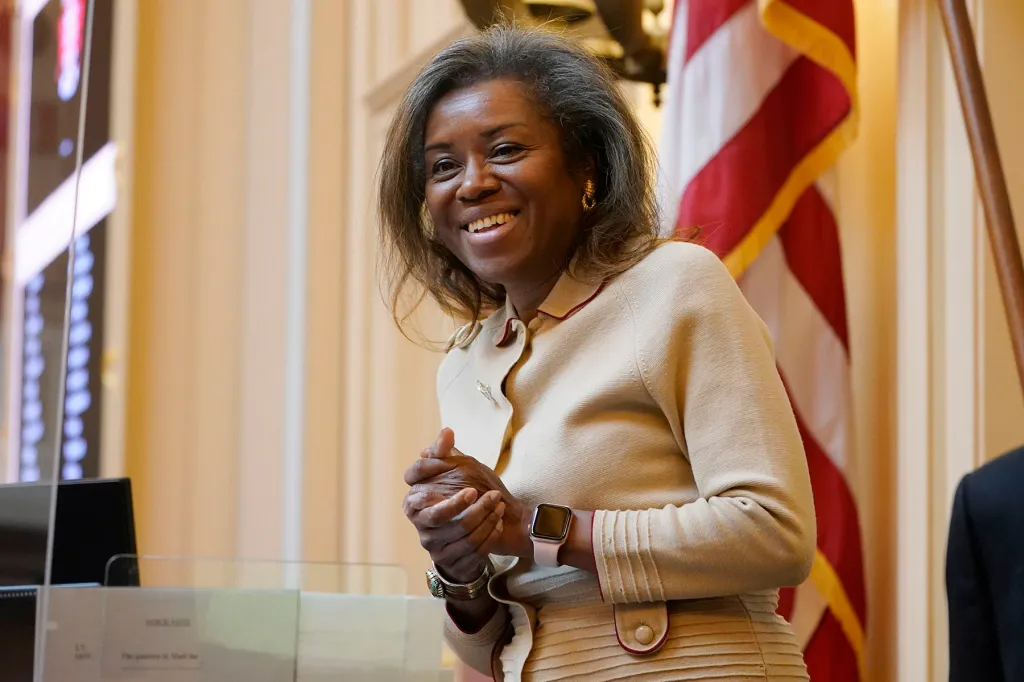
Earle-Sears’ “Life and Marriage Tour,” originally slated to begin in August, held its first event September 9 in Mechanicsville, Virginia, a Republican stronghold roughly 10 miles outside Richmond. The tour’s website implores voters to “protect the lives of babies and traditional marriage” by rejecting each of the proposed amendments, which it claims are “radical and deceptive.”
Earle-Sears plans to speak during more than a dozen stops through November 1, mostly at previously scheduled religious gatherings and local Republican events.
The Log Cabin Republicans — a conservative political organization representing gay, lesbian and bisexual Republicans — has not publicly endorsed the proposal to repeal Virginia’s constitutional ban on same-sex marriage. The organization, founded in the early 1970s to advocate for LGBTQ+ rights within the Republican Party, announced in August that it would no longer advocate on behalf of transgender Americans and would focus exclusively on “issues of sexual orientation,” including marriage equality.
Spokespeople for the group and its Virginia chapter did not immediately return a request for comment.
Virginia is for lovers
Sidrah Marotti and Wynn Maravilla, newly engaged and saving up for a wedding of their own, said they hope their votes this November will help add Virginia to the growing list of states that have rejected their marriage bans.
They met in 2022 while attending graduate school in Northern California, and moved to Richmond last year after Marotti accepted a job there. Maravilla proposed during a visit to Marotti’s grandmother’s farm in North Carolina in January, just before a rare winter storm blanketed much of the state in snow and ice. “The night before, Wynn was like: ‘How much do you trust me?’” Marotti said.
Virginia, the couple said, already feels like home. They’ve made friends with their neighbors, built up a solid queer community and are just a few hours away from Marotti’s family. “I feel more myself than I have in a really long time,” Maravilla said. “Moving here has made a really big difference in our personal lives and in our lives together.”
They were surprised to learn that Virginia’s ban on same-sex marriage was still, technically, part of its constitution.
“The case law is so precarious, and that’s, like, all that’s holding our right to get married in place right now. It feels destabilizing,” Marotti said, though she added that the Supreme Court issued its ruling in Obergefell when she was only a teenager, and Maravilla was in their early 20s.
“It’s been like most of our life that it’s been the standard, and so I feel like it’s not totally hitting me what it would mean,” Marotti said. “I don’t know what it felt like when it wasn’t legal to get married.”
Early voting in Virginia starts Friday. Election Day is November 3.