
Why Monaco Doesn’t Need a Gay District
One question I receive surprisingly often, particularly when people begin making their travel plans, or when a major event such as the Monaco Grand Prix or the Monaco Yacht Show is on the horizon, is whether Monaco has a traditional gay neighborhood.
Feature image by Iballo on Unsplash
Usually, that question is followed by another one: “So where can I meet a rich gay man in Monaco?” Or, in slightly less subtle terms, something along the lines of, “Where do I find a sugar daddy?” I have to admit, the latter still makes me roll my eyes when it arrives in my inbox or comes up in conversation.
The question of whether Monaco has a gay district, however, is much more interesting. The short answer is no. And honestly, I don’t think Monaco needs one.
Monaco Is Simply Too Small — And Too International
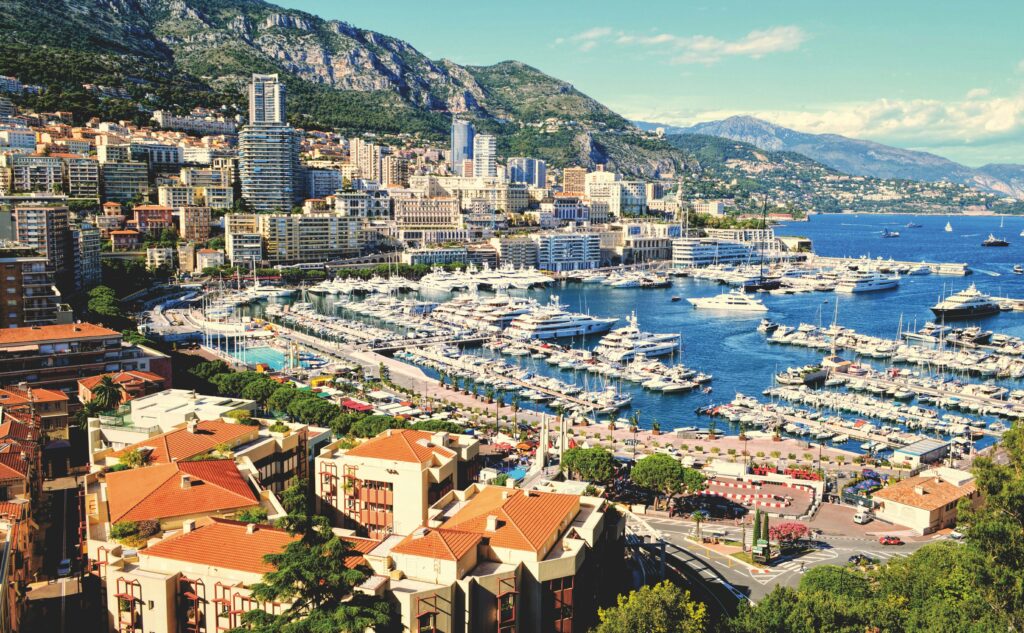
To understand why, you first have to understand Monaco itself. The Principality covers just over two square kilometers and, at the end of 2025, had 38,857 residents. Yet its economy supports an employment population vastly larger than the number of people who actually live there. IMSEE recorded 65,680 salaried employees in 2024, while total employment, including salaried and non-salaried positions, was more than 78,000.
That tells you something important about Monaco. It isn’t really a conventional city. It is a tiny, densely populated international Principality that functions economically as part of a much larger Côte d’Azur metropolitan area.
People live in Monaco, but they also live in Beausoleil, Cap-d’Ail, Roquebrune-Cap-Martin, Menton, Nice and throughout the Alpes-Maritimes. Others commute from Italy. They arrive for work, business, events, holidays, conferences, yacht season, and major sporting events, then leave again.
More than 17,000 people living in Nice alone now commute to Monaco for work, according to figures reported from the Principality’s employment statistics. That is one reason defining Monaco’s social life solely by its resident population can be misleading.
So when someone asks me where the “gay neighborhood” of Monaco is, my first thought is that they are applying a very traditional big-city model to a place where it simply doesn’t fit. Monaco isn’t London, Paris, Berlin or New York. There isn’t the physical space, population structure or necessity for an LGBTQ district in the traditional sense.
There Isn’t a “Gay Monaco”
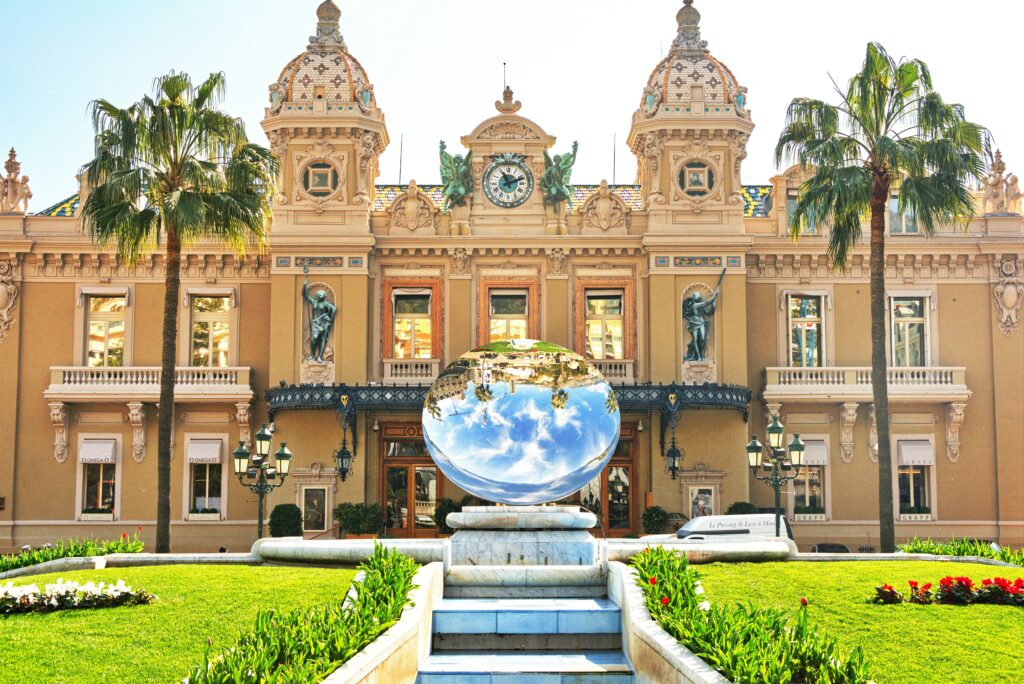
There is no particular street, neighborhood or quarter of Monaco that you can point to and say, “That’s where the gays live.” And I actually like that.
LGBTQ people in Monaco are not confined to one part of the Principality. They are professionals, business owners, hospitality workers, entrepreneurs, residents, visitors and people who simply happen to be passing through.
You may meet someone at a restaurant, at a café, on the beach, at an exhibition, at a private party, at an event, on a boat, walking around Port Hercule, at the Grimaldi Forum or, just like anywhere else, through someone you already know.
That last point matters especially in Monaco. The social world can be remarkably interconnected. You don’t necessarily need a gay bar to meet gay people when your social circles overlap through work, friends, events, sport, business and the wider Riviera community.
That is probably the biggest misconception about LGBTQ life in Monaco: the community exists, it just isn’t geographically concentrated.
The Community Has Its Own Places — Just Not a Gay District
That doesn’t mean LGBTQ life in Monaco is invisible. Quite the opposite.
Mon’Arc-en-Ciel has played an important role in giving LGBTQ people a visible presence in the Principality, advocating for equality and creating opportunities to meet and socialize.
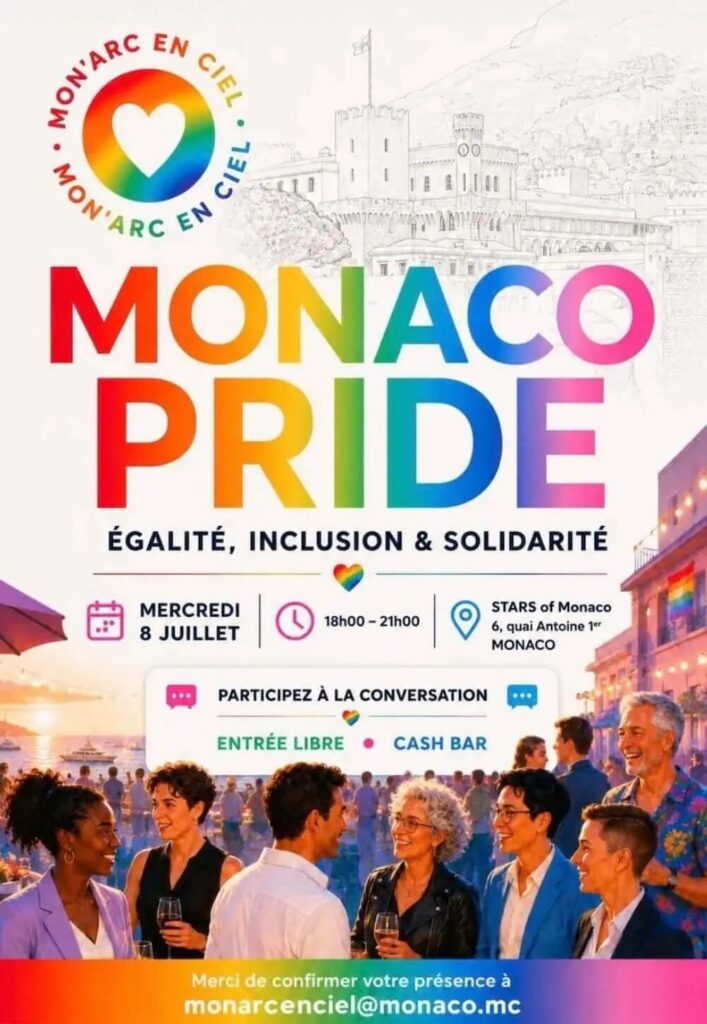
By 2026, Monaco had held five editions of Monaco Pride, creating something that I personally find rather special. It isn’t simply an attempt to replicate the enormous street Pride celebrations found in cities elsewhere. The Monaco model feels much more intimate.
To me, it often feels less like a parade taking over an entire city and more like the community coming together in one expansive room created for us. And perhaps that suits Monaco. It is smaller, more intimate, and more personal, and people actually have the opportunity to talk, laugh, and build relationships with each other. That matters.
Monaco’s LGBTQ Progress Is Real — But It Isn’t Finished
Another side of this conversation shouldn’t be ignored. Monaco has made progress on LGBTQ rights, but it would be inaccurate to suggest that the Principality has reached full equality.
The 2019 law on civil solidarity contracts created the contrat de vie commune, providing a legal framework for couples living together. However, it was deliberately designed as a civil arrangement rather than marriage and does not simply reproduce every right associated with marriage.
There has also been continuing discussion around family and parental rights, while the wider legal framework concerning discrimination, gender identity and LGBTQ equality still has gaps.
That isn’t just an opinion. In its 2026 report on Monaco, the Council of Europe’s European Commission against Racism and Intolerance called for stronger legislation to address discrimination and specifically recommended a comprehensive legal framework covering discrimination, hate speech, and hate crime. It also called for a legal framework explicitly regulating legal gender recognition. The report highlighted concerns about LGBTI-phobic bullying in schools while also noting areas where Monaco has made progress.
So there is a distinction worth making: Monaco can be socially welcoming while its legal framework continues to evolve. Those two things can exist at the same time, and they do. Overall though, recently it feels as though more positive steps have being slowly coming to light because of the efforts from Mon’Arc-en-Ciel.
Why I Don’t Think Monaco Needs a Gay Nightclub
Every so often someone asks why Monaco doesn’t have a dedicated LGBTQ nightclub, gay café or permanent gay venue. My answer is usually that economics and geography don’t particularly make sense.
Monaco has almost no spare space. Property is extraordinarily expensive, commercial premises are expensive, and operating costs are high. A dedicated venue would also have to draw from an audience beyond Monaco’s resident population.
Could a successful LGBTQ business operate in Monaco? Of course. But I wouldn’t automatically assume that putting the word “gay” on the front door makes it commercially viable.
There is another consideration, too. There are already plenty of restaurants, cafés, bars, clubs, beaches and other social spaces where LGBTQ people can go without anyone particularly caring whether they are straight, gay, bisexual or anything else.
Sometimes the most inclusive place is the one that doesn’t need to announce that it is inclusive.
So Where Do The Gays Hang Out?
Anywhere they want. We go to restaurants, have coffee, go to the beach, take casual walks, attend events, meet friends, go to private parties, use dating apps, travel, and work. In other words, Monaco residents live their lives.
There isn’t a magic pink door somewhere in Monaco that opens into a secret gay universe. And perhaps that’s precisely the point. You don’t have to segregate a community in order for that community to exist.
And About That Rich Gay Man…
Now we get back to the question I receive with remarkable regularity: “How do I meet a rich gay man in Monaco?”
I genuinely find this one entertaining.
First, Monaco isn’t a vending machine where you insert a good-looking tourist and receive a wealthy boyfriend. Second, wealth doesn’t necessarily announce itself.
People who actually live in Monaco know there is a considerable difference between someone who has money and someone who wants everyone else to know (or think) they have money.
Monaco is full of people who arrive believing that every expensive car, yacht, restaurant, and hotel represents an invitation. It doesn’t. Thanks for coming.
Wealthy people are in Monaco, obviously. But there are also thousands of people working extraordinarily hard in a very expensive place, and tens of thousands of people commuting into the Principality every day.
If your entire reason for coming to Monaco is to find someone wealthy to finance your lifestyle, you may be walking into the Principality with the wrong expectations. And word has a way of getting out about those intentions without you having to say anything.
People who have lived in and around Monaco for a while develop a kind of sixth sense. You start to recognize who is genuine, who is pretending, who is simply enjoying themselves, who is visiting for three days, who is here for the season, and who actually lives here.
Monaco’s social circles can also be surprisingly interconnected. You may be only one or two degrees of separation from somebody. Friends know friends, people notice who has arrived and, yes, dating apps are used in Monaco just like everywhere else.
But there is something else worth remembering. If somebody is willing to pay for everything, there may be a reason. The more important question isn’t necessarily “What can I get?” It might be “What is going to be the ultimate price?”
Because sometimes the bill doesn’t arrive at the restaurant.
What I Love About The LGBTQ Community in Monaco
This is obviously based on my own experience with people I have met and friendships I have developed over the years, rather than a scientific assessment of Monaco’s LGBTQ population. But many of the people I know in Monaco are genuinely some of the most interesting, charitable and loving people I have ever met.
What I also appreciate is that many don’t seem particularly interested in proving anything. They aren’t necessarily walking around covered in luxury logos, and they don’t need to tell you what their apartment cost or explain which yacht they were invited onto last weekend. They simply go about their lives.
Many are incredibly well-traveled, knowledgeable, articulate, curious and empathetic. Perhaps because Monaco attracts people from so many different backgrounds, you quickly realize that there is no single definition of what an LGBTQ person in Monaco is supposed to look like.
Some people were born into privilege. Others weren’t. Some built businesses, some built careers, some came from extraordinarily difficult backgrounds, and some arrived with very little and built completely different lives for themselves.
Those stories fascinate me most. I’ve heard stories from friends in Monaco about where they came from, what they overcame, and how they eventually built their lives here. For some, the journey has involved considerable hardship.
What strikes me isn’t the money. It is the resilience. And perhaps more importantly, the generosity that often comes with it from experiencing hardship.
Some of my friends have beautiful homes, expensive cars or other things they worked incredibly hard to obtain. But the people I respect most aren’t interested in making you feel inferior because they have them. They simply enjoy their lives.
There is an important distinction: having something isn’t the same as needing everyone else to know you have it.
Monaco Doesn’t Need a Gay District
Could Monaco support a traditional gay neighborhood? Theoretically, perhaps. But geographically, economically and socially, I don’t see the necessity.
Monaco is simply too small, too international and too interconnected for the traditional concept of a gay district to make much sense. What it does need—and increasingly has—is community, visibility, events, advocacy, friendships, places where LGBTQ people can meet, and people willing to keep pushing for equality where the law still has catching up to do.
That is a much better measure of LGBTQ life than whether a rainbow flag hangs permanently over one particular street.
So if you’re coming to Monaco and wondering where the gay neighborhood is, I have some bad news: there isn’t one.
But if you’re asking where the LGBTQ people are, they’re pretty much everywhere.
And if you’re asking where the rich gay men are?
Well… that’s where I’m going to leave you to do your own homework. Bon chance.